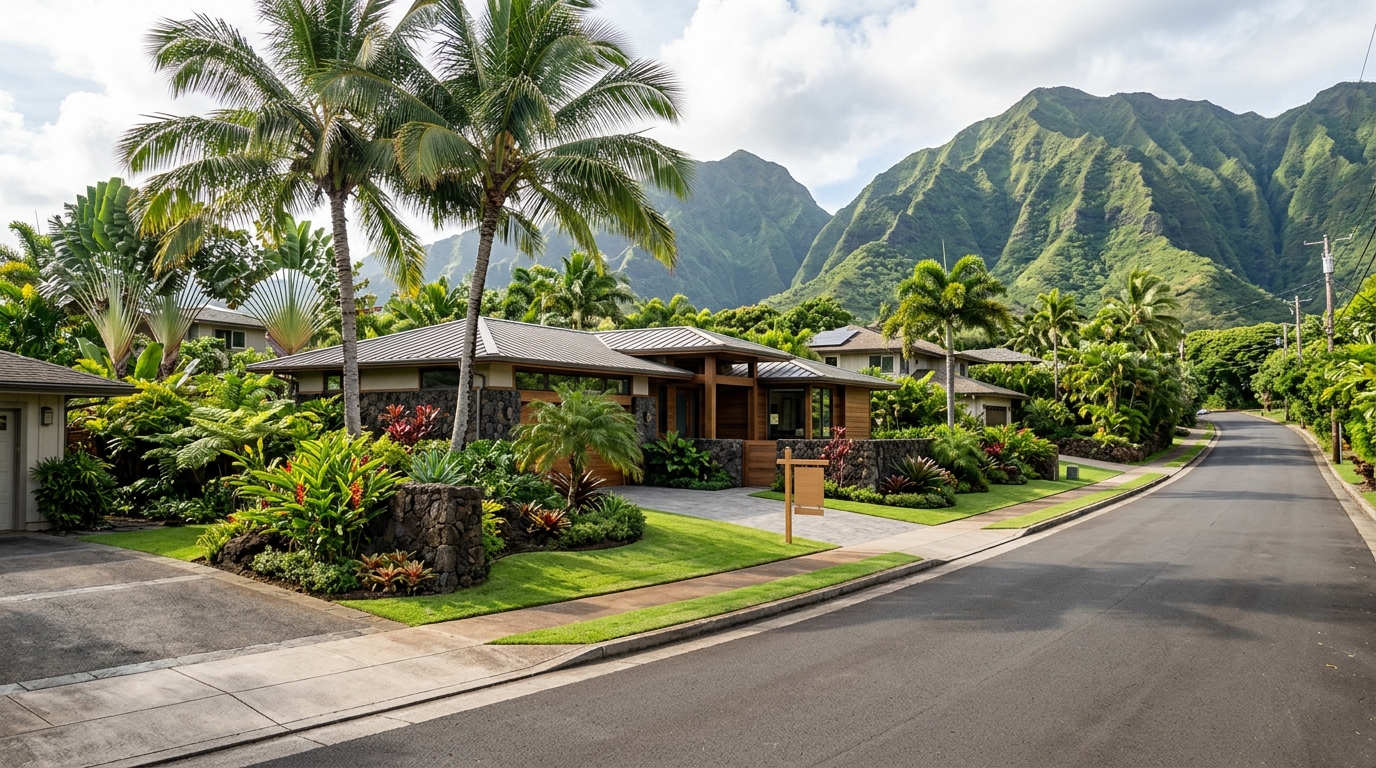
When borrowing costs double in a standard mainland housing market, home prices almost always soften to offset higher monthly debt service. Looking closely at maui single family market trends reveals the opposite pattern, as median sales prices for detached properties have held firm near record highs. Standard economic models assume that rising mortgage rates will automatically push sellers to discount their listings, but island geography and severe physical constraints create an entirely different financial reality.
The Structural Inventory Deficit in Island Housing
Detached housing values stay elevated primarily because the supply of physical land cannot expand to meet ongoing demand. Unlike continental metros where developers can push suburbs miles outward into raw farmland, an island has immutable oceanic and conservation borders. Most land across the county is zoned for conservation or agriculture, leaving only a tiny fraction designated for urban residential use.
This geographic boundary creates a perpetual ceiling on new single-family construction. Building a new neighborhood requires years of infrastructure planning, water allocation approvals, and site work through volcanic terrain. As a result, active inventory levels for single-family residences consistently sit at historical lows, meaning even a modest drop in buyer activity is matched by an even tighter supply of available homes.
When buyers analyze microclimate pricing differences across the island, they quickly discover that each micro-market operates under its own severe supply constraints. Whether looking along the sunny leeward coastline or in the elevated upcountry districts, the number of move-in-ready detached properties for sale at any given time remains exceptionally small. Scarcity protects valuations far more effectively than interest rates suppress them.
Cash Allocation and the Diminished Impact of Debt Costs
Mainland housing markets depend heavily on entry-level buyers utilizing high-leverage financing packages. In contrast, the buyer pool for detached homes on Maui features an unusually high percentage of equity-heavy participants. Many purchasers are relocating professionals, retirees diversifying accumulated capital, or high-net-worth investors acquiring legacy assets.
These buyers do not fund their acquisitions through standard conforming mortgages. A significant share of transactions close entirely in cash, while others involve substantial down payments of forty to sixty percent. While understanding shifts in jumbo loan borrowing power remains relevant for leveraged purchases, a buyer using fifty percent down is far less sensitive to a two-point interest rate swing than an entry-level buyer putting five percent down.
Because cash buyers absorb inventory without relying on bank underwriting approvals, the day-to-day fluctuations in national lending benchmarks fail to derail transactions. The demand side of the equation simply does not contract with the velocity that conventional real estate analysts anticipate.
The Mortgage Lock-In Effect Among Existing Homeowners
Rate hikes also create an unintended consequence on the supply side known as the rate lock-in effect. Homeowners who purchased or refinanced detached properties between 2020 and 2022 secured fixed mortgage rates near three percent. Selling their property today would mean forfeiting that historically cheap financing to purchase an alternative property at prevailing market rates.
Unless an owner faces an urgent life transition, they choose to stay put. This choice freezes existing inventory in place, pulling would-be resale listings completely off the market. Sellers who do choose to list understand their competitive advantage. They know prospective purchasers have almost no competing alternatives in their immediate neighborhood, giving sellers the pricing power needed to protect their equity.
Homeowners tracking these dynamic inventory swings often consult an accurate property valuation assessment to see how limited neighbourhood competition directly impacts their home equity. Even when overall transaction volume slows down, individual closed sales continue to establish strong price per square foot baselines.
Replacement Cost Realities Set a Valuation Floor
A home’s market value cannot be separated from the cost required to replicate it. On Maui, construction costs have surged due to material shipping surcharges, localized supply chain bottlenecks, and a limited pool of licensed trade contractors. Building an equivalent custom single-family home today often costs considerably more per square foot than buying an existing home.
When the cost to grade a parcel, install utilities, ship lumber, and finish an estate exceeds existing resale pricing, existing inventory becomes the economical option. Knowledgeable buyers calculate replacement costs early in their search. When they realize that building from scratch involves years of permitting along with premium construction bids, they willingly pay asking prices for existing homes to secure an immediate timeline.
This dynamic creates a solid pricing floor beneath detached properties. While cosmetic fixers may see occasional downward price adjustments to account for renovation expenses, well-maintained estates and turnkey single-family parcels resist discounting entirely.
What Resilient Pricing Means for Today’s Decisions
The belief that waiting for mortgage rates to fall will yield lower home prices ignores the mechanics of restricted supply. When interest rates eventually ease, the pool of buyers who have been sitting on the sidelines will re-enter the market simultaneously. In an environment where active listings are already constrained, that surge in buyer demand typically sparks accelerated price appreciation rather than affordability.
Understanding these supply mechanics allows both buyers and property owners to operate with clear expectations. Detached island real estate is fundamentally underpinned by land scarcity, persistent cash liquidity, and high replacement costs. Buyers must focus on securing the right microclimate and property profile rather than trying to time national rate cycles.
If you own detached real estate and want to understand how current supply constraints affect your specific parcel, request a detailed property valuation assessment. Our team analyzes hyper-local sales comps and active neighborhood inventory to show you exactly where your property sits in the current market.