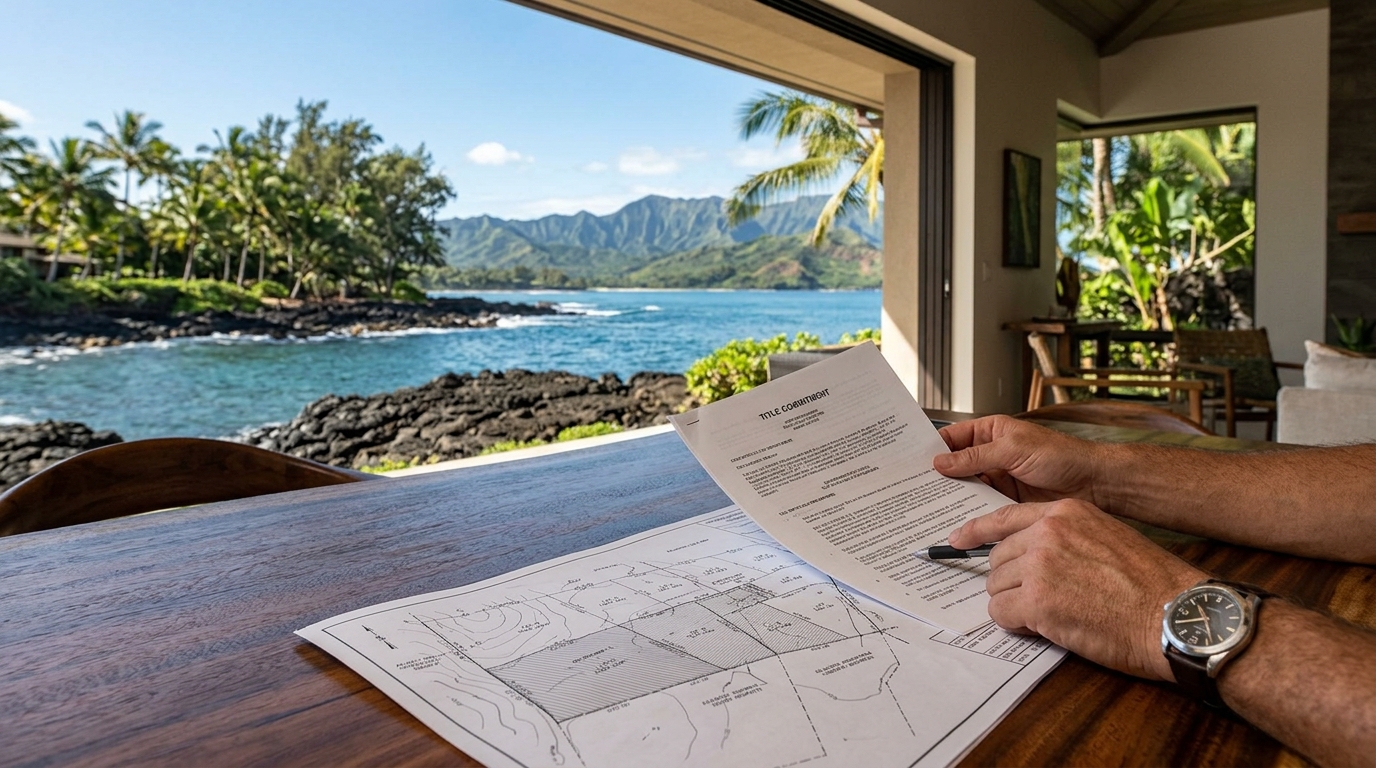
A standard Hawaii purchase contract gives buyers a strict window, typically five to seven days, to approve or reject the preliminary title paperwork. A Hawaii title commitment outlines the exact terms under which a title insurer will issue a policy once ownership transfers, but most buyers scan the document without knowing which clauses threaten their ownership rights. Escrow officers coordinate the paperwork and handle funds, yet they do not advise you on whether a recorded covenant restricts your planned build or whether a neighboring fence sits across your property line.
Schedule B Exceptions Carry the Real Financial Exposure
Every title commitment splits into two main sections: Schedule A and Schedule B. Schedule A details the transaction facts, including the insured amount, the current owner of record, the legal description of the parcel, and the estate being conveyed. Schedule B is where the actual risk sits, divided into pre-printed standard exceptions and special exceptions unique to that specific parcel.
Standard exceptions exclude items not shown by public records, such as unrecorded mechanics liens, boundary discrepancies that only an accurate boundary staking would reveal, and rights of parties in physical possession. Special exceptions list specific encumbrances discovered during the preliminary escrow title search process. These include property tax liens, recorded mortgages, utility easements, and restrictive covenants. If an item appears in Schedule B, the title insurance policy will not cover losses resulting from that issue after closing.
Access Easements and Private Road Obligations
Landlocked parcels and private road systems are common across the Hawaiian islands. If your parcel does not front a dedicated county or state road, your legal access relies entirely on recorded access easements across neighboring private parcels.
When reviewing easements, you must confirm that the easement runs with the land rather than terminating with the prior owner, that it grants ingress and egress, and that it explicitly allows utility line installation. Many rural subdivisions operate on private road maintenance agreements where lot owners share repair expenses. If the title commitment reveals an access easement without a formal, recorded road maintenance agreement, lenders may delay loan funding, and you take on the financial liability of unpaid neighbor road repairs. Buyers preparing to purchase property must demand copies of every underlying easement document referenced in the commitment rather than relying solely on the one-paragraph summary.
Shoreline Boundaries and Dynamic Coastal High-Water Marks
Coastal parcels carry title exceptions that mainland buyers rarely encounter. In Hawaii, private property lines along the ocean do not extend to a fixed coordinate on a map. Under state law, the seaward boundary of private land stops at the upper reaches of the wash of the waves, usually marked by the debris line or vegetation line.
The state holds title to all land seaward of this fluctuating line in public trust. As beaches erode, your legal property line moves inland toward your home. Your title commitment will typically contain specific shoreline exceptions stating the insurer will not defend against claims by the State of Hawaii or the public regarding accreted land, submerged land, or public transit corridors along the shore. Before closing on coastal real estate, buyers must evaluate recorded covenants alongside current coastal shoreline setback regulations to determine whether planned renovations or existing structures sit inside mandatory setback buffer zones.
Land Court Versus Regular System Registration
Hawaii uses two parallel property recording systems: Land Court (Torrens system) and Regular System. Some parcels fall under both, referred to as the Double System.
|
System Feature |
Land Court |
Regular System |
|---|---|---|
|
Governing Registry |
Bureau of Conveyances / Land Court |
Bureau of Conveyances |
|
Title Document Issued |
Transfer Certificate of Title (TCT) |
Recorded Deed / Regular System Document |
|
Adverse Possession Claims |
Not permitted by state law |
Permitted under strict statutory terms |
|
Boundary Certainty |
High; backed by state decree |
Depends on recorded deeds and metes |
|
Document Processing Time |
Requires court approval for changes |
Standard recording timeline |
Land Court parcels come with a state-guaranteed Transfer Certificate of Title. A major benefit of Land Court is that no party can acquire title to your land through adverse possession or unrecorded prescriptive easements. However, Land Court requires strict conformity. Any unrecorded change, such as a name change, probate transfer, or unapproved boundary modification, can stall closing until the Land Court petitions are formally processed.
Encroachment Discrepancies and Boundary Tolerances
Boundary surveys frequently reveal rock walls, fences, driveways, or roof eaves crossing property lines. Hawaii Revised Statutes Section 669-11 establishes de minimis structure position discrepancies. These statutory tolerances define minor boundary variations that do not constitute an actionable encroachment:
-
Residential property: 0.50 feet (6 inches)
-
Commercial property: 0.25 feet (3 inches)
-
Agricultural and rural property: 0.75 feet (9 inches)
-
Conservation property: 1.50 feet (18 inches)
If an improvement crosses a property line by more than the statutory allowance, it is an active encroachment. The title commitment will flag this finding once survey maps are submitted. In response, you must secure a formal encroachment agreement from the neighboring property owner, requiring them to acknowledge the intrusion, waive removal demands, and bind subsequent buyers. If a neighbor refuses to sign an encroachment agreement, the title underwriter will exclude that boundary dispute from your policy coverage.
Mineral Rights, Water Reservations, and Kuleana Access
Title commitments in Hawaii frequently note reservations of mineral rights, geothermal rights, and water resources to the State of Hawaii or original aliʻi estates dating back to the Great Māhele of 1848. These reservations prevent private owners from claiming commercial water extraction rights or geothermal royalties beneath their land.
Commitments may also reference customary native Hawaiian rights under the state constitution. Kuleana rights grant descendants access across private parcels to gather traditional materials, access family burial plots, or tend agricultural lands. These rights exist by law even when not visible on the ground. A title exception noting traditional access rights does not invalidate your deed, but it establishes that your ownership is subject to lawful cultural access protocols across designated portions of the parcel.
Evaluating every exception on your preliminary paperwork eliminates surprises before your contractual contingency windows expire. If you want high-velocity representation and clear insight as you examine high-stakes real estate opportunities, use our buyer services platform to start your search with absolute clarity. Our team executes prompt property walkthroughs and helps you review the ground realities behind every parcel across the islands.