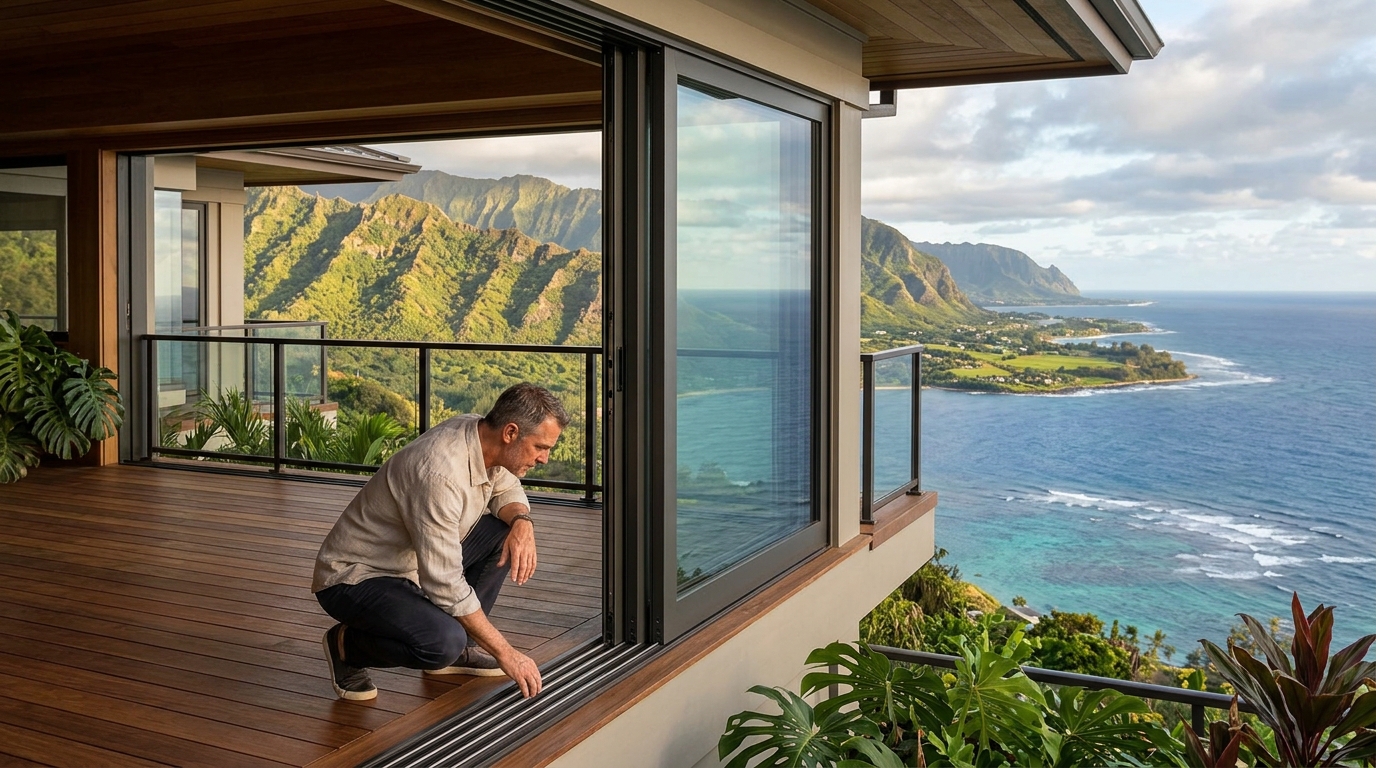
An elevation gain of five hundred feet above the coastline doubles the wind load on an exterior wall and dramatically accelerates airborne salt deposition. Properties positioned along elevated ridgelines capture expansive ocean horizons and cooling breezes, but the daily reality of oahu ridge living maintenance involves distinct structural demands. Trade winds force moist, salt-laden marine air directly against exposed siding, roof junctions, and window assemblies, wearing down exterior finishes far faster than in protected valley bottoms.
Trade Wind Velocity and Building Envelope Pressure
Elevated ridges act as natural compression ramps for northeast trade winds. Air currents forced up steep mountain topography gain velocity as they crest the ridge, turning standard twenty-mile-per-hour coastal breezes into sustained thirty-five to forty-five-mile-per-hour gusts. This continuous airflow places structural envelopes under relentless positive pressure on the windward side and strong negative suction on the leeward face.
Over time, sustained pressure pushes wind-driven moisture past standard flashing details and through micro-fissures in exterior stucco or siding. Water that enters these assemblies during squalls does not easily escape, leading to hidden framing moisture or dry rot if weep screeds and ventilation cavities are compromised. Understanding how elevation and airflow alter cooling demands across different microclimates also highlights why mechanical ventilation must be balanced with exterior wall durability.
Standard architectural seals, weatherstripping, and caulking fail twice as fast on an exposed hillside as they do in lower elevation neighborhoods. Homeowners must inspect silicone joints around windows, sliding pocket doors, and roof penetrations annually rather than waiting for five-year service intervals.
Salt Air Corrosion on Elevated Fasteners and Glazing
Many buyers assume that building several miles inland or hundreds of feet above sea level removes the risk of marine corrosion. In reality, strong trade winds carry atomized sea spray straight up the mountain slopes, depositing concentrated chlorides across ridge properties every afternoon. When combined with morning dew and evening mist, this residue creates an aggressive electrochemical environment.
Standard galvanized framing nails, exterior bracketry, and entry-level stainless steel hardware corrode rapidly in this setting. Exterior light fixtures, garage door torsion springs, and air conditioning condenser fins often show visible rust within three years if made from low-grade metals. Grade 316 marine-grade stainless steel, solid brass, and powder-coated architectural aluminum are required specifications for any exposed hardware.
Glazing systems face similar challenges from airborne grit and salt crusting. High winds propel fine volcanic dirt and mineral particles against glass panels, which can etch unprotected window surfaces over decades. Regular freshwater rinses are necessary to prevent salt deposits from baking into exterior glass under intense afternoon sunlight.
Managing Oahu Ridge Living Maintenance Through Material Selection
Building longevity on a ridgeline comes down to using materials engineered for constant atmospheric abrasion. When you prepare to buy a hillside property, evaluating building orientation against prevailing trade winds protects you from unexpected exterior capital expenditures down the road.
Exterior wall claddings perform very differently under ridge conditions:
-
Engineered Fiber Cement: Resists rot and dimensional movement during wet weather cycles, holding exterior finishes better than conventional softwood siding.
-
Natural Hardwoods (Ipe and Teak): Dense hardwoods withstand wind wear exceptionally well on lanais, though they require penetrating oil finishes every twelve to eighteen months to prevent silvering and surface checking.
-
Cementitious Stucco: Requires elastomeric primer coats to bridge hairline surface fissures that form when high-velocity wind loads flex wood framing.
-
Standing Seam Metal Roofing: Aluminum or zinc panels outperform coated steel, as cut edges on steel sheets will oxidize when exposed to salt-laden hillside mist.
Before purchasing or altering an elevated home, owners must also review past modifications carefully. Checking for unpermitted lanai enclosures and structural add-ons is critical, as unpermitted work on wind-exposed ridgelines frequently skips the heavy shear-wall fastening and hurricane clips required by modern building codes.
Exterior Paint Degradation and Recoating Cycles
On valley floor properties, a quality exterior paint job generally lasts eight to ten years before requiring substantial recoating. On an elevated ridge, that timeline contracts to four to six years on windward exposures. High UV radiation at elevation breaks down paint binders, while constant wind friction physically scours the micro-layer of topcoat protection.
The first indicator of coating failure is chalking, where the paint resin degrades into a loose, powdery film that washes off during rainstorms. Once chalking occurs, the underlying substrate loses its moisture barrier, allowing rain driven by trade winds to penetrate concrete masonry or wood substrates. Regular pressure washing using low-pressure broad spray nozzles removes surface salt before it can chemically react with topcoats.
In addition to exterior building maintenance, site factors such as hillside driveways and retaining walls demand dedicated inspection. Steep topography alters how water moves across the parcel during heavy storms, and daily travel down ridgelines shapes how traffic and elevation affect daily Oahu commutes. Clearing hillside swales, testing French drains, and ensuring sub-surface drainage lines remain clear of root intrusion prevent soil hydrostatic pressure from undermining foundation footings.
Protecting Your Hillside Property Investment
Hillside real estate offers unmatched sightlines and natural ventilation, but maintaining an elevated exterior requires consistent attention to hardware, paint systems, and drainage infrastructure. Factoring these maintenance intervals into your operational budget ensures your estate retains its structural integrity and market value. If you are preparing to acquire a hillside residence, our team can help you evaluate building envelopes and identify high-performance construction before you write an offer. Explore our curated buyer inventory and private showing services to target hillside properties built to endure ridgeline weather conditions.