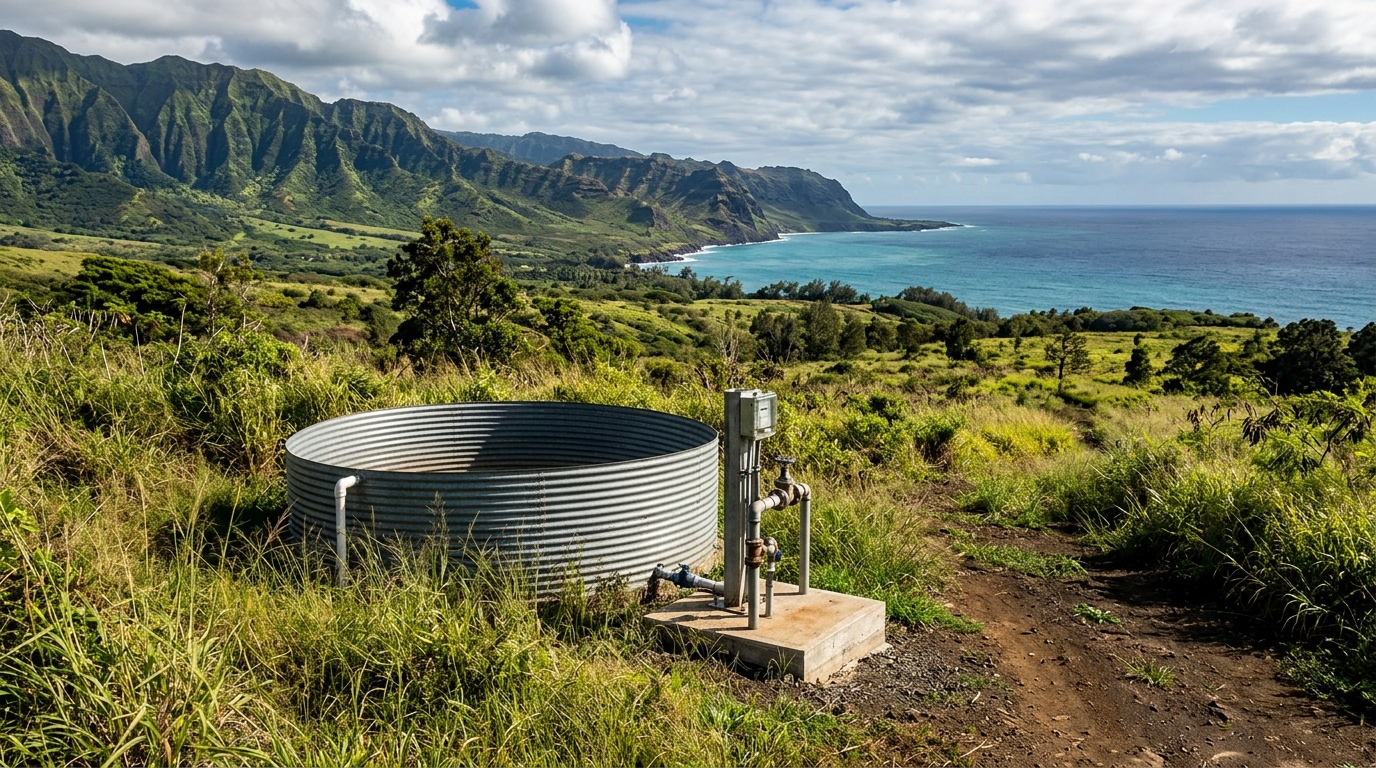
Buying vacant land sounds simple until you run into municipal utility limitations. When evaluating maui agricultural acreage, water access determines what you can build, how quickly you can break ground, and what your ongoing land operations will look like. Securing an agricultural parcel without a verified county water source can leave you holding raw ground for years while waiting on infrastructure approvals.
The Maui County Water Meter Priority List
The County Department of Water Supply manages potable connections across the island. For decades, demand has exceeded distribution capacity in several major districts. The county maintains a formal water meter priority list, where hundreds of parcel owners wait for available allocations.
A parcel listed for sale with an active application on file does not mean a meter is imminent. Meter applications do not automatically convey priority position to a buyer without specific administrative transfers. In some districts, applicants have waited more than a decade for meter issuance because source development and storage tank upgrades remain unfinished.
Before entering escrow, request the official application number and verify its status directly with the Department of Water Supply. Never assume a nearby water main guarantees service to your parcel boundary. If the county system lacks adequate pressure or storage reserves at your elevation, service approval will stall indefinitely.
Agricultural Water Rates and Dedicated Farm Meters
A standard residential connection supplies domestic potable water for household consumption and fire suppression. However, running an orchard, nursery, or pasture requires significantly higher volume. For substantial cultivation, property owners must apply for an agricultural water rate or install a dedicated dual-service meter.
Qualifying for reduced agricultural utility rates requires proving commercial agricultural production. The county requires active farming activity, such as livestock management, food crop sales, or commercial nursery propagation. Properties with non-commercial landscaping do not qualify for subsidized farm rates, meaning standard residential tiered pricing applies to every gallon used.
When you prepare to acquire acreage on maui, calculating utility operating costs in advance protects your balance sheet from unexpected monthly overhead. Excessive consumption on high-tier residential rates can easily add thousands of dollars to your monthly property expenses.
Private Water Systems and Agricultural Ditches
Certain agricultural subdivisions operate private shared water utilities instead of county municipal lines. These private companies maintain their own reservoirs, wells, and distribution piping. Private systems often feature specific allocation limits, typically measured in gallons per day per parcel.
Private water utilities charge distinct monthly maintenance fees and infrastructure assessments to repair aging lines. In many rural agricultural pockets, ditch networks originally built for commercial plantations still deliver non-potable ditch water for irrigation. Ditch water is raw, untreated surface run-off that cannot legally enter a residential tap without extensive personal filtration.
If your parcel relies on agricultural ditch access, verify water rights recorded in the property deed. Historical rights can fluctuate based on stream restoration mandates and county environmental agreements. Surface water flows can drop significantly during dry summer months, which directly alters how you plan your crop cycles or pasture irrigation.
Rainwater Catchment System Regulations
When county water is unavailable, buyers often ask if rainwater catchment can support a luxury residence. On maui, building codes dictate how and when catchment systems satisfy permit requirements for residential occupancy. How water falls also varies widely based on how rainfall patterns split across the island.
The building department requires approved minimum storage volumes, reliable mechanical filtration, and dedicated fire suppression reserves before signing off on a residential building permit. A standard single-family home on catchment typically needs a storage tank capacity ranging from 10,000 to 30,000 gallons, depending on structural square footage. You must also account for pump pressure, ultraviolet purification, and sediment filtration to maintain potable safety standards.
Fire department requirements present another hurdle for catchment parcels. If a county hydrant is not located within standard hose-laying distance of your building site, you must provide on-site water storage dedicated exclusively to fire protection. This requirement often demands an extra standalone tank equipped with a commercial fire department connection fitting.
Agricultural Zoning and Dwelling Restrictions
Owning agricultural acreage comes with statutory restrictions governed by county zoning ordinances and state land use commissions. The primary purpose of agricultural zoning is food production, conservation, and farming, not speculative residential development. Constructing a single-family home on agricultural land is permitted as a farm dwelling, but you must align your plans with farm use requirements.
Many buyers plan to build a main home, a guest cottage, and agricultural outbuildings. However, county rules limit residential density based on parcel acreage. In addition, getting permits for an accessory farm dwelling requires active farming revenue or ongoing commercial production plans submitted to planning authorities.
Operating a working parcel also links directly to managing agricultural tax assessments and carrying costs over the life of your ownership. Combining dedicated farm production with proper water capacity allows you to maintain favorable property tax classifications while meeting county land-use obligations.
Wastewater Planning and Well Feasibility
Water delivery is only half of the site infrastructure equation. You must also plan for wastewater handling in compliance with state environmental mandates for wastewater systems. Most rural acreage relies on private septic tanks and absorption fields, which require specific setbacks from private wells, catchment tanks, and property boundaries.
Drilling a private well on your acreage is an alternative if the property sits above an accessible freshwater aquifer. However, private wells involve significant upfront capital expenditure. You must secure permits from the Commission on Water Resource Management, complete hydrologic engineering studies, and drill through hard volcanic rock.
Well depth varies dramatically across the island based on elevation and distance from the coastline. Pumping water from deep underground requires substantial electrical infrastructure or solar power storage. In coastal zones, over-pumping can introduce brackish intrusion, requiring commercial reverse-osmosis filtration before the water is usable in a home.
Infrastructure Due Diligence Checklist
-
County Meter Verification: Review the written meter status letter from the Department of Water Supply to verify existing connections or list numbers.
-
Flow Rate Testing: Perform a physical flow rate and pressure test on existing agricultural connections to evaluate volume under peak demand.
-
Private System Covenants: Examine private water association bylaws, daily consumption caps, and reserve fund balances for system maintenance.
-
Catchment Viability: Measure annual rainfall averages at your specific elevation to ensure adequate natural collection capacity.
-
Fire Reserve Compliance: Confirm fire department hookup specifications and required dedicated tank capacities with local building authorities.
Investing in acreage requires looking past natural beauty to verify utility capacity before drafting architectural plans. Our team tracks county water records, infrastructure limits, and development rules across the islands. Connect with us through our real estate acquisition consultation to review verified parcels that fit your construction timeline.