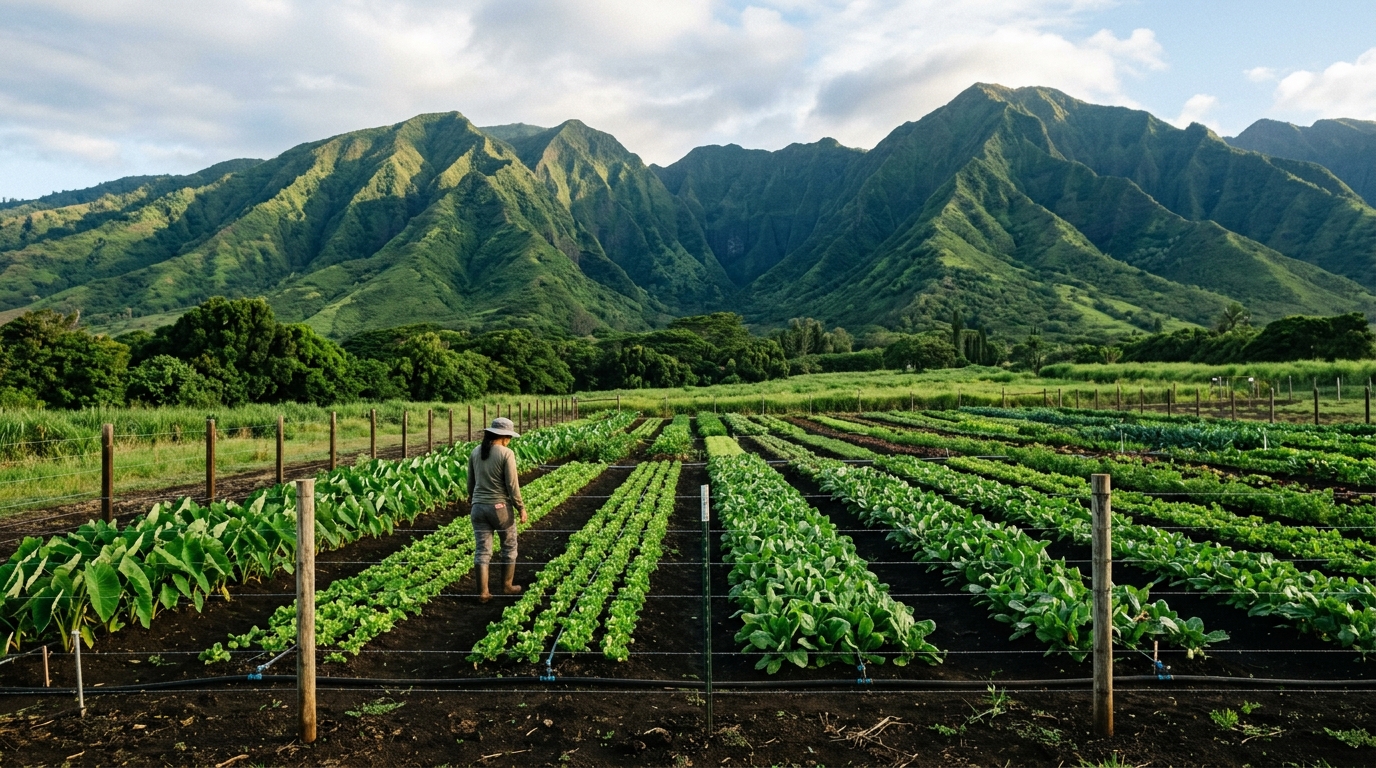
Buying acreage classified under state and county farming designations requires more than simply mowing grass or planting fruit trees around a driveway. Executing a valid hawaii agricultural zoning lease means meeting strict statutory production minimums, managing active commercial cultivation, and registering agreements properly with local tax offices. State Land Use Commission statutes set specific baselines for what activities maintain agricultural compliance on rural parcels.
State Land Use Classifications and Commercial Production Minimums
Land classified within the State Agricultural District under Chapter 205 of the Hawaii Revised Statutes must serve genuine agricultural pursuits. Soil classifications rated Class A or B through the Land Study Bureau carry the highest level of protection. On these high-capacity soils, residential use is strictly ancillary to ongoing commercial activity. You cannot build a primary dwelling on this land without maintaining an active farming operation.
To satisfy county tax offices across hawaii, maui, kauai, and oahu, property owners often lease acreage to third-party farmers. A dedicated farm agreement transfers operational duties to an experienced grower who manages crops, livestock, or orchard yields. County tax assessors inspect these parcels periodically to verify that cultivation covers the legally required percentage of usable ground. When you structure an acquisition through our buyer representation services, reviewing agricultural lease documents and production records is an essential early step.
If you fail to meet cultivation minimums, the county revokes your agricultural dedication. That loss triggers immediate reassessment at higher general property tax rates. Furthermore, tax offices apply retroactive rollback penalties that span multiple years of back taxes, accompanied by substantial statutory interest charges.
Structuring a Hawaii Agricultural Zoning Lease for Dedicated Ground
A handshake deal with a neighborhood grower will not satisfy county zoning examiners or real property tax boards. Every lease must define the exact footprint under cultivation, the commodity produced, and the schedule of commercial harvests. Written agreements should specify access corridors, equipment storage rights, and irrigation utility splits.
The lease term must also align with county dedication cycles. Dedication programs across maui, kauai, and oahu typically run in ten-year or twenty-year commitments. Executing a short-term, month-to-month agreement creates compliance risks if a tenant walks away midway through an assessment cycle. Aligning lease terms directly with the governing county dedication window protects the parcel against sudden status cancellations.
For parcels subject to dedicated covenants, understanding hawaii agricultural tax assessment rules helps owners structure lease pricing that balances tenant profitability with tax stability. Most lease arrangements on dedicated ground feature reduced cash rent in exchange for the tenant handling all required county reporting and property maintenance.
Water Allocations and Farm Infrastructure Requirements
Commercial agriculture depends entirely on dependable water volume. Agricultural parcels across the islands obtain water through county municipal meters, private ditch systems, or on-site agricultural wells. Many county water departments apply discounted rates for verified agricultural accounts, provided the property owner submits continuous proof of commercial sales.
Before executing any contract, calculate whether current water allocations support your tenant farmer’s crop selection. As highlighted in our review of maui agricultural acreage water access, county infrastructure often restricts meter sizes on rural acreage. High-water crops like diversified row vegetables require substantial daily volume, whereas orchard crops like macadamia or cacao require less intensive distribution networks once established.
The table below summarizes common agricultural dedication standards and tenant obligations across rural island parcels:
|
Factor |
Standard Requirement |
Tenant Lease Obligation |
|---|---|---|
|
Minimum Dedicated Term |
10 to 20 years depending on county |
Multi-year operational commitment matching the tax petition |
|
Cultivation Area |
Typically 50% to 85% of usable acreage |
Continuous weed suppression, planting, and harvesting |
|
Commercial Proof |
Annual excise tax records or gross sales receipts |
Submission of wholesale or retail revenue receipts annually |
|
Water Sourcing |
Dedicated agricultural meter or private catchment |
System maintenance and payment of operational water utility bills |
Dwelling Permissions and Worker Housing Compliance
A frequent point of friction involves building residential homes on rural acreage. State law permits farm dwellings on agricultural parcels, but a farm dwelling is defined legally as a single-family house located on and used in connection with a working farm. County planning departments increasingly withhold building permits until an applicant proves active farming operations.
If you intend to build additional structures for farm laborers, statutory rules require stringent verification. Agricultural labor dwellings require demonstrated commercial volume, verified tax returns from farming revenue, and established parcel gross income. You cannot construct second dwellings on rural parcels without providing verified agricultural production figures to county building officials.
When purchasing rural acreage, distinguishing between fee simple vs leasehold property distinctions is equally critical. A fee simple owner controls both the underlying real estate and the authority to grant long-term farm leases, whereas a leasehold owner operates under a master ground lease that may restrict subleasing rights or agricultural enterprise types.
Maintaining Compliance and Avoiding Penalty Rollbacks
County tax inspectors conduct random field audits on dedicated agricultural parcels across hawaii, oahu, maui, and kauai. Assessors examine tree counts, row conditions, and general weed management. A parcel overgrown with invasive scrub or guinea grass fails inspection quickly, even if a written lease document sits on file in county archives.
To avoid tax rollbacks and land use citations, enforce these operating standards throughout the lease tenure:
-
Require Annual Harvest Proof: Require tenants to provide copies of general excise tax filings or commercial bills of lading demonstrating crop sales.
-
Document Boundary Maintenance: Establish contractual obligations for perimeter mowing, firebreak maintenance, and feral animal mitigation.
-
File Written Leases Promptly: Submit recorded lease agreements to the real property tax division immediately following contract execution.
-
Preserve Water Monitoring Logs: Maintain detailed pump or meter logs to prove that water usage correlates with commercial farm operations.
A properly executed agricultural lease preserves your tax status while creating a functional partnership with local agricultural operators. Reviewing municipal code requirements before signing agreements protects your capital investment and maintains parcel compliance year after year.
Navigating rural land rules requires decisive action and accurate local property data. If you are evaluating rural acreage or planning your next land acquisition across the islands, explore our dedicated buyer representation services to examine parcel records and secure compliant properties with absolute certainty.